
When trimming is the right call
- Dead or broken limbs. Deadwood falls on its own sooner or later, often in the first strong wind. Removing it is the single most useful thing pruning does for safety.
- Limbs over the roof. Branches rubbing shingles wear them down, pile leaves and pine straw in roof valleys, and give squirrels a bridge onto the roof.
- Clearance. Raising the lower limbs over a driveway, sidewalk or street so trucks, mowers and people can pass.
- Storm preparation. Removing crossing, rubbing and weakly attached limbs, and reducing long, heavy branches, lowers the chance of breakage in a summer downburst or an ice storm.
- Light and air. Thinning a dense crown lets light reach the lawn and lets the tree dry after rain.
When the problem is the tree itself, such as decay in the trunk, a big lean toward the house, or a pine that is dying, trimming only delays the inevitable. The tree risk checklist helps you tell the difference.
What good pruning looks like
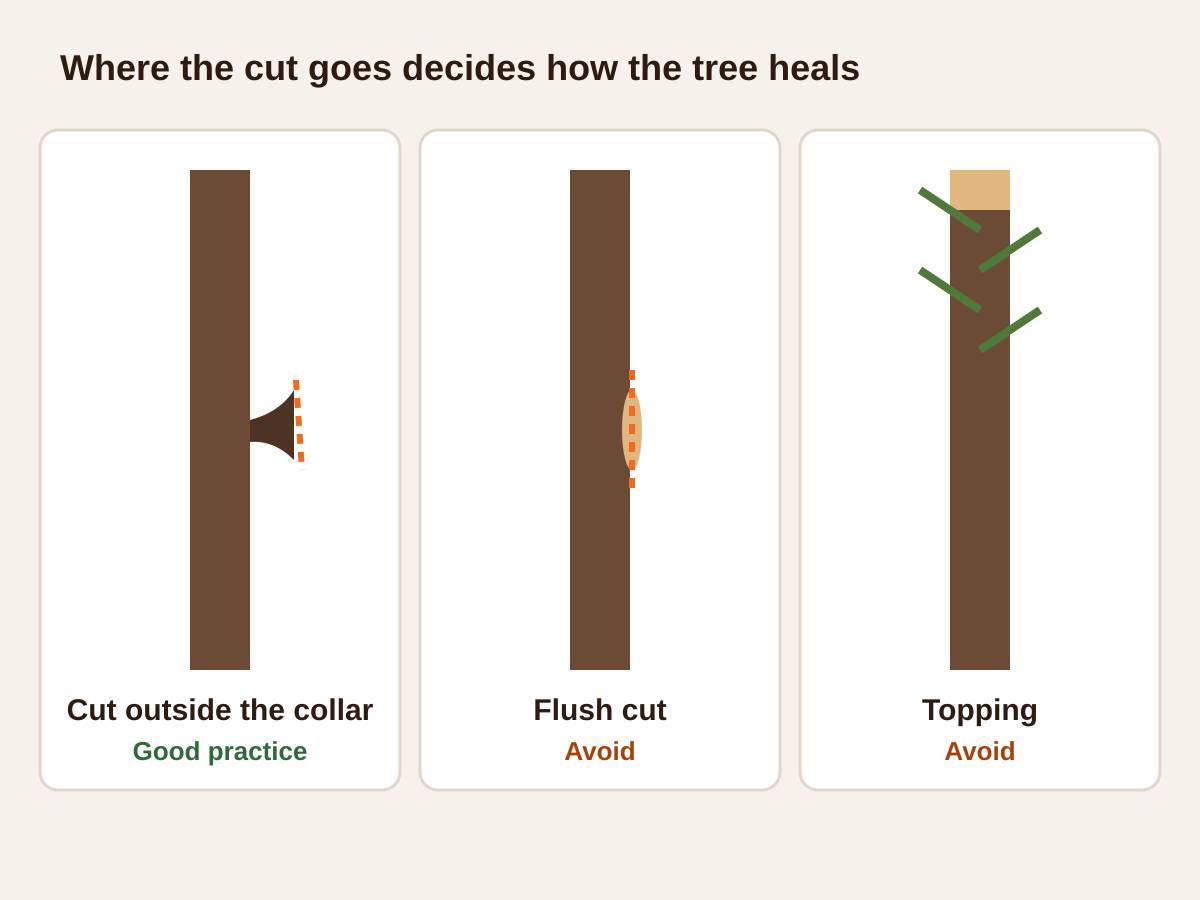
Trees don't heal the way skin does. They seal wounds off, and they do it best when a cut is made just outside the branch collar, the slightly swollen ring where a branch joins the trunk. A cut flush against the trunk removes that collar and lets decay in. A stub left sticking out rots back into the trunk. In the U.S., the ANSI A300 pruning standard spells out these cuts; it's fair to ask a pro whether they follow it.
The work itself usually includes:
- Cleaning: removing dead, dying, diseased and broken branches.
- Raising: removing lower limbs for clearance over structures, drives and lawns.
- Reducing: shortening long limbs back to a strong side branch, rather than cutting them off at random points.
- Thinning: removing selected branches to open the crown, without stripping out the inner growth. Stripping out everything but a tuft at the end of each limb, sometimes called "lion's tailing," makes limbs more likely to snap.
Climbers working in a tree for pruning should not use climbing spikes on a tree that is staying. Spikes wound the bark with every step, and those wounds are an easy entry point for insects and decay. Ask about it.
What to avoid: topping
Topping is cutting a tree's main stems back to stubs to make it shorter. It is still common around the Midlands, especially on pines and crape myrtles, and it does real harm. The tree responds by pushing out fast, weakly attached sprouts from below the cuts, decay moves into the stubs, and within a few years you have a tree that is as tall as before and much more likely to drop limbs. If a tree is too big for its spot, removal and replanting with something that fits is almost always the better use of your money.
Trimming the trees Lexington yards actually have
Loblolly pines
Pines are mostly trimmed for deadwood and clearance. Their lower limbs die off naturally as the tree grows, and dead pine branches break easily. Heavy pruning of live pine crowns is rarely helpful, and fresh wounds on stressed pines can draw bark beetles in warm months, so cooler months are generally a safer time for bigger cuts.
Water, willow and laurel oaks
The most common shade trees in older neighborhoods. Deadwood and long, heavy limbs over houses are the usual work. Oaks that shed big dead limbs year after year may be declining from decay in the trunk, which a good pro will point out.
Bradford pears
Their tight, upright forks are built to split. Pruning young trees early to thin out competing leaders helps. On mature Bradfords that are already splitting, removal is usually the safer choice.
Crape myrtles
The "crape murder" stubs you see along roads are a form of topping. Crape myrtles bloom fine with light thinning and removal of crossing branches.
Magnolias, pecans and sweetgums
Southern magnolias often need lifting over walkways; pecans drop heavy, brittle limbs and benefit from deadwooding; sweetgums are usually trimmed for clearance and to reduce the seed-ball mess over patios.
Trees near wires
Trimming anywhere close to an overhead line is specialized work. Pruning near the main lines along the street is for the utility and specially trained line-clearance crews. For limbs near the wire to your own house, ask the utility whether it needs to disconnect the line first. Never prune near a line yourself, with a pole saw or otherwise. See trees near power lines in Lexington County.
What drives the cost of trimming
- Height and size of the tree, and whether it can be reached with a bucket truck or has to be climbed.
- How much work: a quick deadwood pass costs much less than a full structural prune.
- What is underneath: limbs over a roof or pool are lowered on ropes instead of dropped.
- Number of trees done in the same visit.
- Cleanup: chipping and hauling brush, or leaving wood for firewood.
Typical ranges are in the tree cost guide.
Questions to ask a pro about trimming
- What exactly will you remove, and roughly how much of the live crown?
- Will you use climbing spikes on a tree that is staying?
- Do you follow the ANSI A300 pruning standard, and is anyone on the crew an ISA arborist? (ISA certification is voluntary in South Carolina; check any credential yourself.)
- Is brush cleanup and hauling included?
- Is there anything about the tree that makes you think it should come down instead?
If the answer to that last question is yes, see dead and dying tree removal or tree removal in Lexington.