
In the first minutes
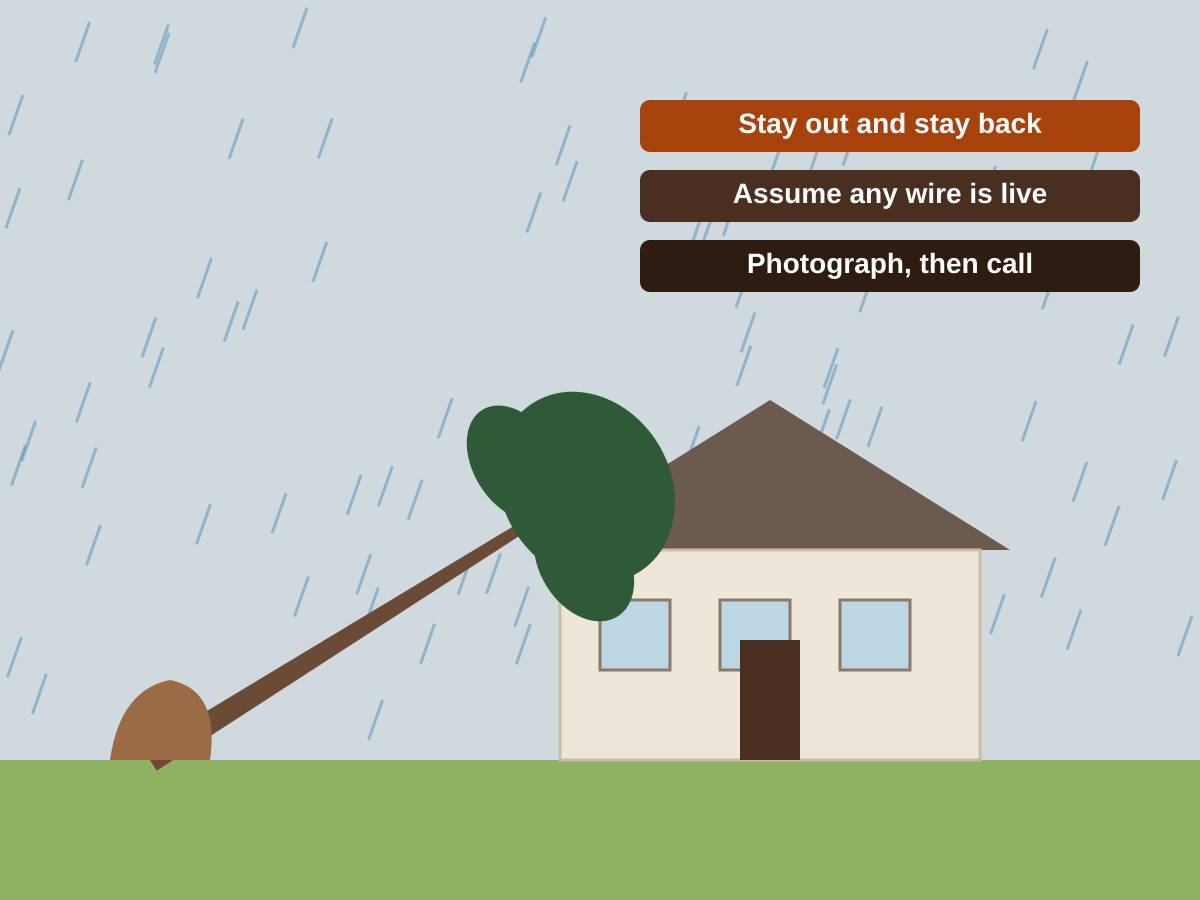
- Get everyone out of the damaged part of the house. A tree resting on a roof can shift, and ceilings under it can come down. If the damage is serious or you smell gas, leave the house entirely.
- Stay away from wires. A tree that fell on a house often took the service line down with it. Assume every wire is live, keep everyone away, and report it to your electric provider. Trees near power lines explains who handles what.
- Call 911 if anyone is hurt or trapped, or if there is fire, a gas leak or a live wire in a place people can reach.
- Shut off utilities if you safely can. Water, if pipes are broken; electricity at the main panel, if it is dry and away from the damage; gas only if you know how and it's safe.
In the first hours
- Document everything before it moves. Wide shots of the tree and house from several angles, close-ups of where the tree broke or uprooted, the roof, every ceiling stain, broken windows, the fence, the car. Video helps. Note the date and time.
- Call your insurance company to open a claim. Ask whether they want an adjuster to see the tree in place, and what they expect you to do to prevent more damage in the meantime.
- Call a tree pro. Tell them it's on the house, how big it is, and whether any wires are involved. Our number is (803) 784‑3426; we'll connect you with an experienced local professional. After a county-wide storm, crews get busy fast, so ask when someone can realistically come out.
- Protect the inside. Move valuables and electronics away from leaks, put down buckets and towels, and keep pets away from broken glass.
Getting the tree off the house
This is not a job to do yourself, and it's not a job for just anyone with a chainsaw. A tree on a roof is under tension and resting on damaged structure; cut the wrong piece and it can roll, spring or crash further into the house. A professional will usually:
- Assess how the weight is carried and what is holding the tree in place.
- Rig the tree from above, sometimes with a crane, so pieces are lifted off rather than dropped onto the roof.
- Remove the tree in sections, working from the top down.
- Leave the roof clear so it can be tarped. Ask whether they tarp or whether you need a roofer for that.
Get a written estimate and an itemized invoice. Your insurer will want both. Don't sign over your insurance benefits to a contractor you just met on your doorstep. See storm damage tree cleanup for more on how these jobs work.
The insurance claim
Common patterns in homeowners policies, which you should confirm against your own policy or with your agent:
- Damage to the house from a tree felled by a covered event (wind, lightning, ice) is usually covered, minus your deductible.
- Removing the tree from the house is often covered, usually up to a set limit.
- The part of the tree in the yard, and trees that fell without hitting a structure, may not be covered.
- Hurricane or named-storm deductibles can be much higher than your regular deductible and may apply when damage comes from a named storm like Helene.
- Fences, sheds and detached garages are usually covered under "other structures," with their own limit.
- Cars hit by a tree are covered by your auto policy's comprehensive coverage, not your homeowners policy.
Keep a folder with the photos, the estimate, the invoice, any tarp or emergency repair receipts, and a log of every call with the insurer.
When the tree was your neighbor's
This is the question everyone asks. In general, when a healthy tree falls in a storm, it is treated as an "act of God," and each owner's insurance covers damage to their own property. A neighbor is more likely to be responsible if the tree was obviously dead, dying or dangerous and they had reason to know it. The details depend on the facts, so treat this as general information, not legal advice.
That is why a written note to a neighbor about a dead or leaning tree matters: it shows they were told. If you are the one with the questionable tree, deal with it before the storm. The tree risk checklist helps you tell a real danger from a messy tree.
Branches that hang over the property line are a different matter. In many places you may trim them back to the line at your own expense, as long as you don't damage or kill the tree, but check with a lawyer if there is any dispute. Talking first saves a lot of friction.
After the tree is gone
- Roof and structural repairs. Hire a roofer or contractor who holds any license South Carolina requires for the work, and follow your policy and local building rules. Ask the Town of Lexington or Lexington County whether your repair needs a building permit.
- The stump and root plate. An uprooted tree leaves a crater and a root plate; a snapped tree leaves a tall stump. Both can be dealt with by stump grinding.
- The other trees. If one tree went over, look hard at its neighbors. They may have lost the wind protection it gave them, or have root damage from its fall.
- Debris. After major storms, ask the county or your town how storm debris will be collected and how it should be placed at the curb before you pile it up.
Before the next storm
Hurricane season runs from June through November, and summer thunderstorms can be just as damaging in a single yard. Walk your yard each spring, deal with dead pines and dead limbs over the house first, and keep a tree pro's number and your policy number in your phone. Dead and dying tree removal and tree trimming cover the usual fixes, and the cost guide covers the prices.