
If a tree is actively cracking, lifting out of the ground, or resting on a wire, don't use a checklist. Get people out of its reach and call. For wires, report it to your electric provider first; see trees near power lines. For the tree, call (803) 784‑3426.
Before you start: what could it hit?
Arborists talk about risk as two things multiplied together: how likely the tree or a limb is to fail, and what it would hit if it did. A dead pine at the back of a wooded lot in Gilbert is a low risk even though it will certainly fall. A healthy-looking water oak with a cracked fork over a child's bedroom in a West Columbia neighborhood is a high one.
So before looking at the tree, look around it. Estimate its height (the FAQ below has a pencil trick) and note everything inside that circle: the house, the driveway, where cars park, the deck, the pool, play areas, fences, the street and any overhead wires. Those targets decide how much the signs below matter.
The printable checklist
Walk around the tree twice: once close to the trunk looking at the base and bark, once from a distance looking at the whole crown. Binoculars help with tall pines.
| Where | What you see | What it usually means | Urgency |
|---|---|---|---|
| Whole tree | New or increasing lean, especially after rain or wind | Roots may be failing on the uphill side | Now |
| Whole tree | Pine crown turning yellow, orange or rust-brown | The tree is dying, often from bark beetles | Soon |
| Ground | Soil cracked or heaved up on one side of the trunk | The root plate is lifting | Now |
| Ground | Mushrooms, shelf fungus or conks on roots or base | Root or butt rot | Soon |
| Ground | Roots cut in the last few years for a drive, pool or addition | Lost anchoring and a likely decline | Watch |
| Trunk | Vertical crack, or a split between two trunks | Structural failure in progress | Now |
| Trunk | Cavity, hollow sound when tapped, or oozing wounds | Internal decay; how much matters | Soon |
| Trunk | Resin blobs (pitch tubes) or fine reddish sawdust on pine bark | Bark beetle attack | Soon |
| Trunk | Bark falling off in sheets; heavy woodpecker work | Dead or dying wood underneath | Soon |
| Crown | Dead limbs, or broken limbs hanging in the crown | Limbs likely to drop in the next wind | Now |
| Crown | Thin crown, small leaves, dieback at the top | Root stress or decline | Watch |
| Crown | Tight V-shaped forks (common on Bradford pears) | Weak attachment that can split in wind or ice | Watch |
| Targets | Any of the above within reach of the house, a bedroom, the driveway or a wire | Raises every other sign one level | Now |
From Lexington SC Tree Removal (lexingtonsctreeremoval.com). General guidance only; it is not a professional tree risk assessment.
Step 1: The ground and the roots
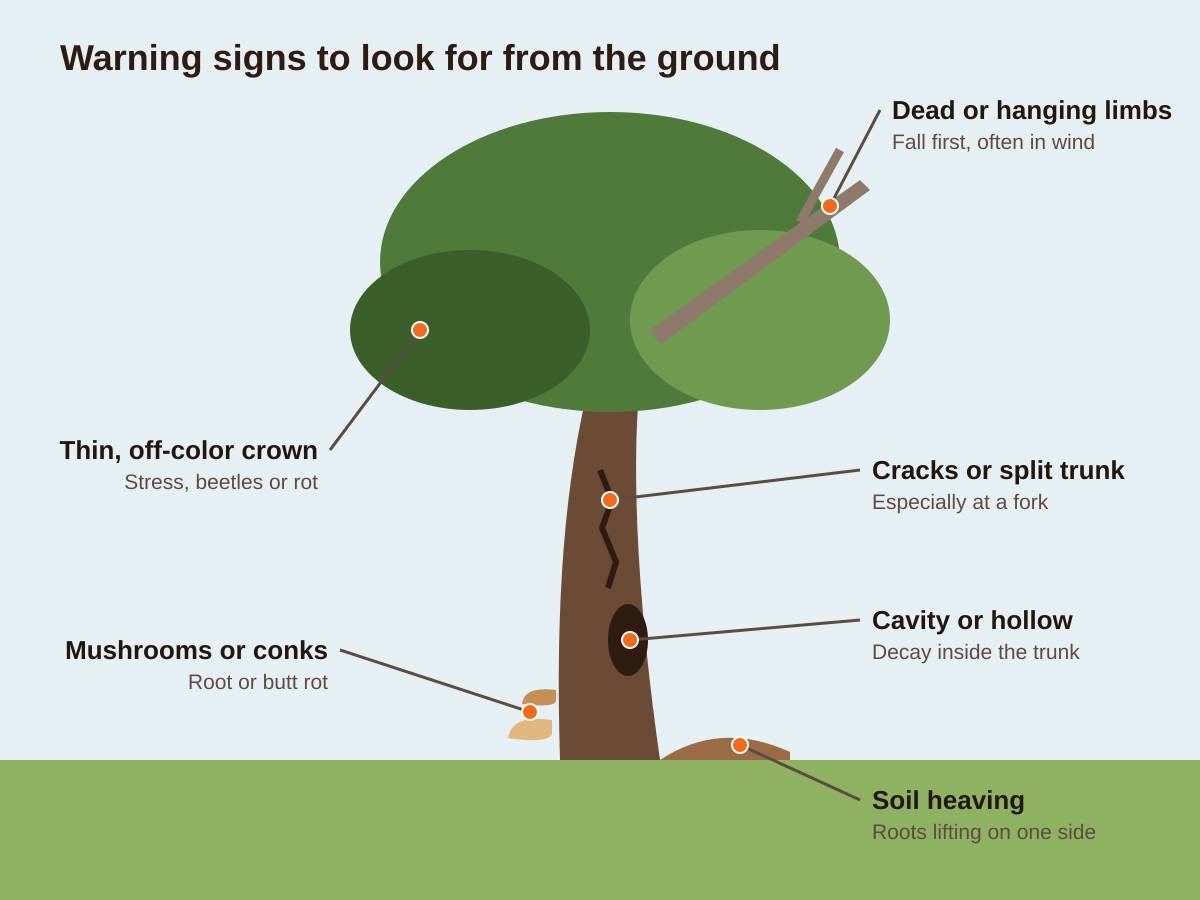
Most whole-tree failures start below ground. Look at the soil in a circle around the trunk.
- Heaving or cracked soil on one side, often with the lawn lifted like a lid, means the root plate is moving. Roots in waterlogged ground lose their grip after days of rain, whether the soil is clay, as it often is near Lake Murray and Chapin, or sand, as it often is toward Gilbert and Pelion.
- Mushrooms, conks or shelf fungus at the base or on roots mean wood-decay fungi are at work. Some species, like the ones that cause butt rot in oaks, can hollow out the base while the crown stays green.
- Cut or buried roots. A driveway widening, a new patio, a pool, trenching for utilities, or soil piled over the roots during construction can kill a tree slowly. Many subdivisions around Lexington were built among existing pines and oaks, and the damage can take five to ten years to show.
Step 2: The trunk
- Cracks and splits. A vertical crack, or a seam opening where two trunks meet, is one of the clearest signs of coming failure. Bradford pears split this way constantly.
- Cavities and hollow sounds. A hole in the trunk, or a hollow knock when you tap it with a rubber mallet, means internal decay. The question is how much sound wood remains.
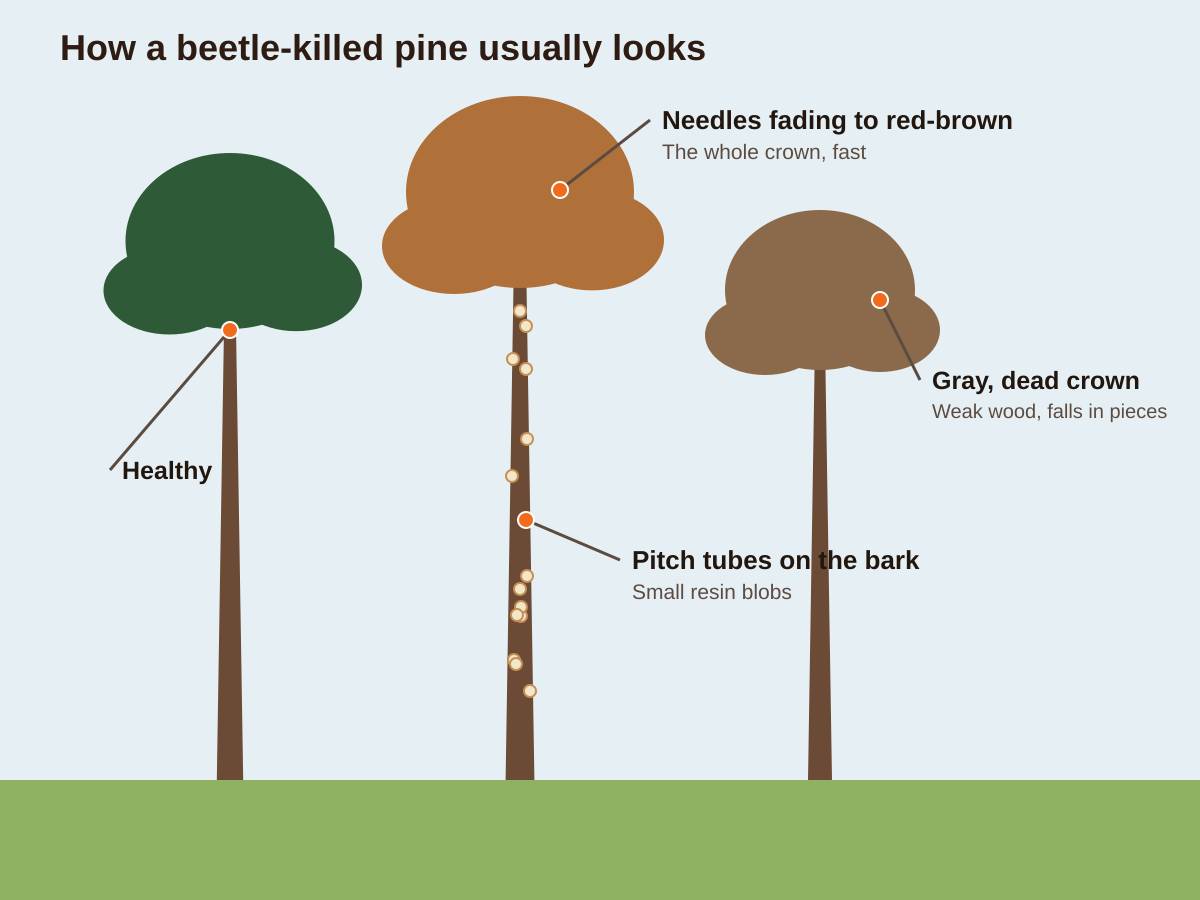
- Resin blobs and sawdust on pines. Pea-sized blobs of pitch on the bark, or fine reddish boring dust in the bark plates and at the base, mean bark beetles are attacking. A healthy pine can sometimes push them out; a stressed one usually can't.
- Loose bark and woodpeckers. Bark falling off in sheets, or woodpeckers working all over the trunk, usually means dead wood and insects underneath.
- Lean. A tree that has always leaned and has corrected itself with a curved top is less worrying than a straight tree that has started leaning recently.
Step 3: The crown
- Dead or hanging limbs. Look for branches with no leaves or needles, and for broken limbs caught in the crown. These are the most common thing to fall in a summer storm.
- Color and density. A pine whose whole crown fades from green to yellow to rust-brown in a few weeks is dying. A hardwood with a thin crown, small leaves and dead twigs at the top is in decline.
- Weak forks. Branches or trunks joined in a tight V, with bark pinched between them, are weakly attached. Water oaks and Bradford pears are prone to this.
- Crown shape after a storm. A pine that lost its top, or an oak that lost a big limb, is exposed to decay and wind in new ways. Look again a few months later.
What the common Lexington trees tend to do
Loblolly pine
The dominant yard tree in the county. Healthy loblollies are strong, but their tall, heavy crowns catch wind, and stressed pines draw bark beetles. The biggest warning signs are a fading crown, pitch tubes and a new lean. Dead pines dry out and grow brittle, so the longer one stands, the harder and riskier it is to take down.
Water and laurel oaks
Fast-growing and widely planted, and prone to internal decay as they age. Watch for large dead limbs, fungus at the base and cavities. A green crown doesn't mean a sound trunk.
Sweetgum
Generally sturdy, but heavy horizontal limbs can fail, and their surface roots are easily damaged by construction.
Bradford (Callery) pear
Built to split. Most mature Bradfords around Lexington have tight, upright forks that fail in wind and ice. They also spread invasively, so many horticulture experts now recommend replacing them with native trees.
Pecan and older yard trees
Big pecans in older neighborhoods drop heavy limbs, especially after heavy nut years and in ice.
What to do with what you found
- Any "Now" sign near a target: keep people and cars out of the fall zone and get a pro out this week. Call (803) 784‑3426 or request an estimate.
- "Soon" signs: get it looked at within a few weeks, and before hurricane season if you can. Dying pines go on the list first. See dead and dying tree removal.
- "Watch" signs: photograph the tree from the same spots and check again after every major storm and each spring and fall. Dead limbs alone can often be handled with trimming.
Whatever you decide, write down what you saw and when. If the tree is near a property line, share it with your neighbor. And if you are on Lake Murray, check the shoreline rules before any cutting: see Lake Murray and Chapin.
Share this checklist
HOA boards, lake associations and real estate agents are welcome to link to this page or print the checklist for residents. It is general guidance, not a professional assessment, and it is most useful before storm season starts in early summer. Related guides: a tree fell on your house and trees near power lines. Costs are in the tree removal cost guide.