
Why deal with a stump at all?
Plenty of people leave stumps alone for years. That can be fine at the back of a wooded lot. Near the house or in a lawn, there are good reasons to grind:
- Mowing and safety. A stump a few inches high is easy to miss in tall grass and hard on mower blades, ankles and anyone running across the yard.
- Insects. Decaying wood attracts termites, carpenter ants and wood-boring beetles. Subterranean termites are common in South Carolina, and a rotting stump close to the foundation is not something to keep around.
- Sprouts. Sweetgums, Bradford pears, sumacs and some oaks keep sending up shoots from the stump and roots. Grinding the stump slows that down considerably.
- Room to use the space. You cannot lay sod, pour a patio, set a shed or plant a replacement tree on top of a stump.
- Selling the house. A yard full of stumps is one of the first things a buyer notices after a big removal.
How stump grinding works
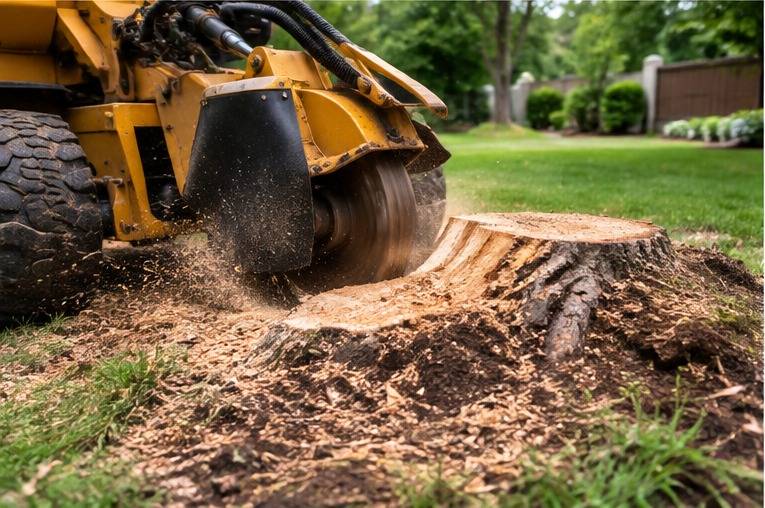
A stump grinder is a machine with a heavy spinning wheel set with carbide teeth. The operator sweeps the wheel back and forth across the stump, taking off a little wood with each pass and working down below the soil line. The stump turns into a mix of chips and dirt. Nothing is pulled out of the ground, which is why grinding does far less damage to a lawn than digging a stump out with an excavator.
A typical visit goes like this:
- A look at the stump and the ground around it. Diameter at ground level, how many big surface roots run out from it, and whether there are rocks, a fence, a foundation or a sidewalk close by.
- Checking for buried lines. Irrigation, landscape lighting, cable and gas lines are often closer to the surface than people think. Public lines should be marked through SC 811, and private lines need to be pointed out.
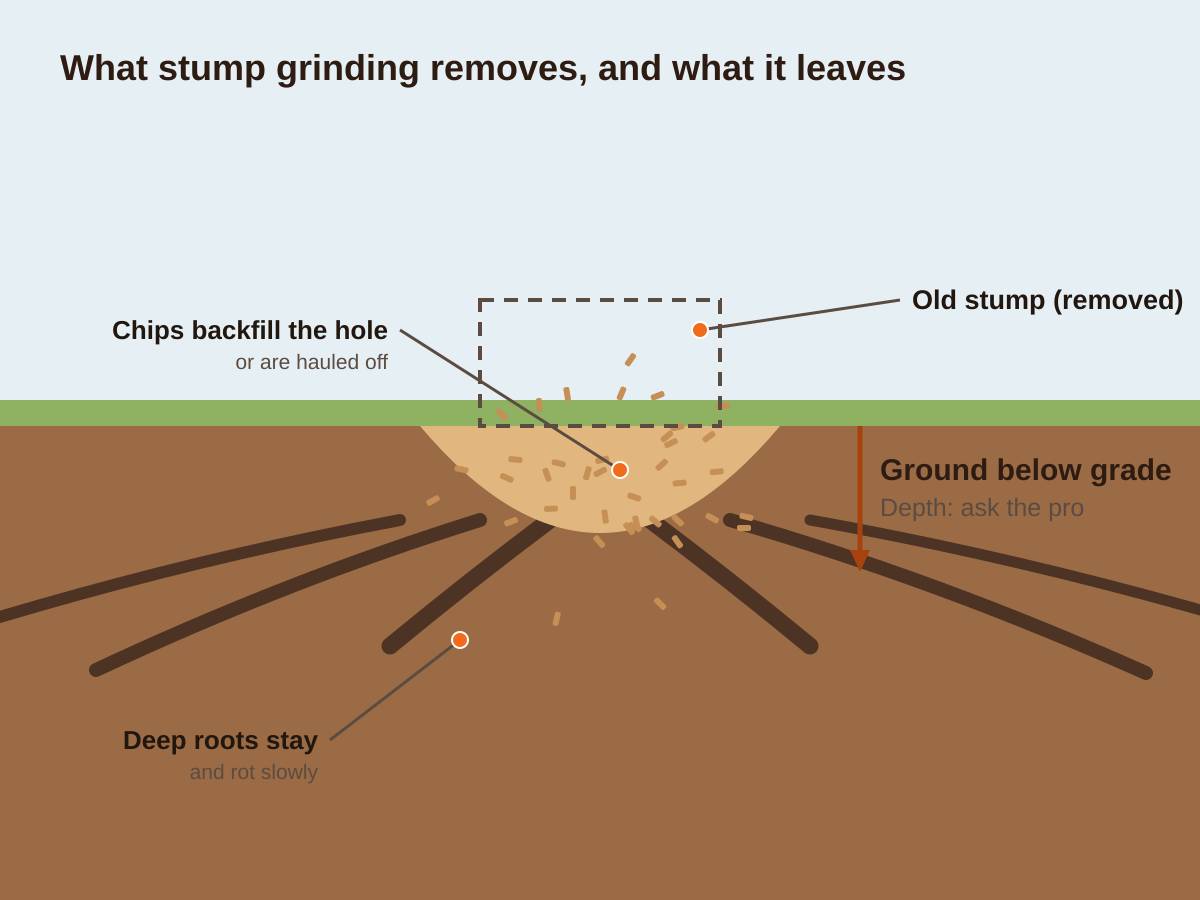
- Grinding. Usually a few inches below the surface for lawn, deeper if you asked for it. The operator also grinds the larger surface roots within a few feet of the stump if that is in the scope.
- Cleanup. Chips raked into the hole and mounded, spread, or hauled off, as agreed.
Stumps in Lexington County yards
Pine stumps
Loblolly pines are the most common tree taken down around Lexington, so pine stumps are the most common stumps. They are resinous and fairly easy to grind, and pines don't resprout. Their roots spread wide and shallow in the sandy soils toward Gilbert and Pelion, so decide whether the surface roots should be ground too.
Oak and sweetgum stumps
Big water oak and willow oak stumps are wide at the base and take longer. Sweetgum stumps come with a web of surface roots that bulge through the lawn, and they tend to sprout. If the roots are lifting a walkway or a driveway edge, say so; grinding the roots is a different job from grinding the stump.
Old, rotten or hidden stumps
A stump left from a storm years ago may be half rotted, overgrown with vines, or buried under mulch in a bed. Rotten stumps grind quickly but can hide rocks or old fencing wire. Point out every stump you want done, including the ones in beds.
Access: the part people forget
Most Lexington subdivisions have fenced backyards, and many have narrow side yards between houses. Stump grinders come in sizes from walk-behind machines that fit through a gate to large tow-behind units. Measure your gate before you call. If it is narrower than the pro's smallest machine, a fence panel may need to come off. Soft ground matters too: after a week of rain, a heavy machine can leave ruts across a lawn, and a good pro will suggest waiting or laying down mats.
On Lake Murray lots, stumps on a steep slope toward the water need extra thought. Grinding stumps inside the shoreline buffer is not the same as removing trees there, but it is still disturbance near the water; ask the pro whether the lake rules apply to your spot. See tree work on Lake Murray.
Grinding vs. full stump removal
Grinding leaves the deeper roots in the ground to rot, which takes years but causes no harm under a lawn. Full removal digs out the root ball with an excavator, leaving a large hole to fill. That is usually only worth it when you are building on the spot or need the ground cleared for a foundation or a pool. For most yards, grinding is quicker, cheaper and much easier on the lawn and irrigation.
Chemical stump removers sold at hardware stores speed up rot, but on a large pine or oak stump it still takes many months, and you are left with a soft, spongy stump to dig out. Burning stumps is a poor idea near houses and in dry spells, and outdoor burning comes with rules; check with the SC Forestry Commission and Lexington County or your town first.
What drives the price of stump grinding
- Diameter at ground level, measured across the widest point, including the root flare.
- Number of stumps. The first stump carries most of the trip cost; each additional one is usually cheaper.
- Surface roots you want ground as well.
- Depth beyond the standard lawn depth.
- Access through gates, down slopes or across soft ground.
- Cleanup: leaving the chips versus hauling them away.
The Lexington tree cost guide has typical ranges. For a real number, call us and we'll connect you with a pro for a free estimate.
Questions to ask before you hire
- What depth is included, and what does deeper cost?
- Are surface roots included, and how far out from the stump?
- Who arranges the utility locate, and what about private lines?
- Will the chips be left, spread or hauled away?
- What size machine will you bring, and will it fit through my gate?
- Do you carry liability coverage in case a rock is thrown into a window or car? Check any credential you rely on.
Still have the tree standing? Most pros will quote the removal and the stump together. Start with tree removal in Lexington or, for a pine that is already dying, dead and dying tree removal. Not sure the tree needs to go? Walk through the tree risk checklist first.