
If a tree or limb is on a wire right now: stay back, keep children and pets away, don't touch anything the tree is touching (including a fence or a car), and report it to your electric provider. Treat every downed wire as live, even if your lights are out.
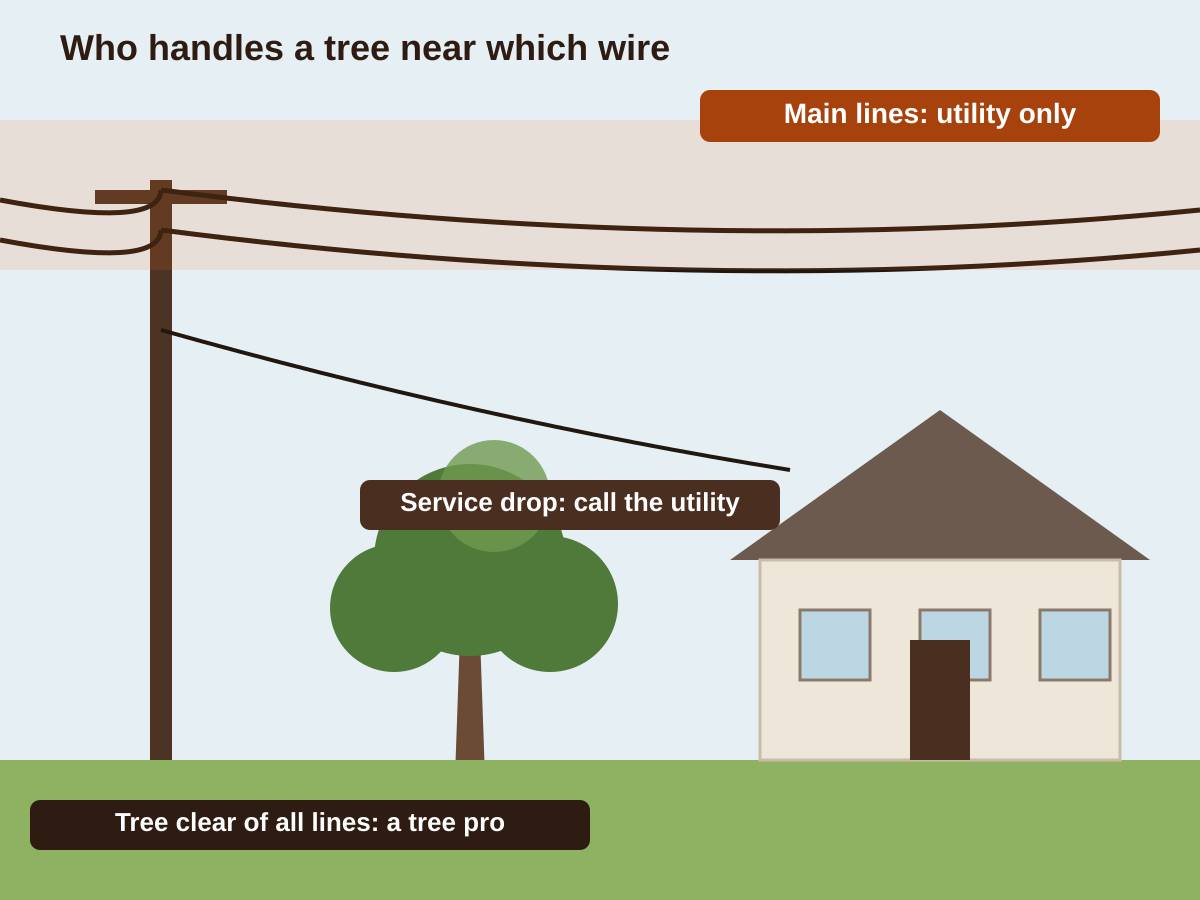
Three kinds of lines, three sets of rules
1. Main distribution lines along the road
These are the wires on the poles along your street or along the back of your lot. They carry high voltage between neighborhoods and belong to the utility. Federal safety rules keep ordinary tree workers a safe distance from them, and work close to these lines is for specially trained line-clearance crews. Call the utility about any tree near its lines; a private tree crew should work there only in coordination with the utility.
2. The service drop to your house
The single cable (or bundle) running from the pole to the weatherhead or meter on your house is the service drop. It carries lower voltage but can still kill. Utilities may not trim trees along service drops as routine maintenance. Ask yours whether it can disconnect or drop the line so a tree pro can work safely, and how much notice it needs.
3. Trees that are simply near a line
A tree that isn't touching anything but could reach a line if it fell is the gray area. If it could hit the main lines, tell the utility; it may put it on its list. If it could hit only the service drop, it is usually yours to deal with, and a tree pro can plan the removal so the tree falls away from the wire or arrange for the line to be dropped first.
Dominion Energy and Mid-Carolina Electric
Most homes in Lexington County get electricity from one of two providers:
- Dominion Energy South Carolina (formerly SCE&G) serves many homes in Lexington County and keeps trees clear of its lines through a vegetation management program.
- Mid-Carolina Electric Cooperative serves many members in Lexington County and neighboring counties and also clears trees along its lines. Members can ask the cooperative about a specific tree near its lines.
Both utilities cut for line clearance, not appearance. Expect trees along a right-of-way to be trimmed back hard or into a V or L shape around the wires. If a tree under the lines is one you care about, the long-term answer may be to replace it with a low-growing species planted well away from the wire.
After a big storm like Hurricane Helene in 2024, huge numbers of customers can lose power at the same time, much of it from trees. That is when a tree across a service drop can wait days for the utility, and when calling the utility first matters most.
Why you should never cut near a line yourself
- Electricity arcs. You don't have to touch a high-voltage line to be hurt; current can jump through the air, through a wet branch or through a tool.
- Trees conduct. Living wood holds water. A branch touching a line can be energized all the way to the ground.
- Ladders and pole saws are not insulated. Aluminum ladders are the worst, but wet fiberglass isn't safe either.
- Falling trees don't go where you planned. A tree hung up on a line can release suddenly when a cut is made, pulling wires, poles and equipment with it.
- Back-feed. A downed line can be re-energized by a neighbor's generator hooked up without a transfer switch.
What a tree pro does near lines
An experienced tree professional will look at where the tree is relative to every line, and plan around it:
- Call the utility if the tree is near the main lines, or schedule a disconnect of the service drop if it's near the house line.
- Plan the fall or the pieces so that nothing can swing into a wire. Near lines, most trees come down in small sections lowered on ropes.
- Keep safe distances with every person, tool and piece of equipment.
- Leave anything within the utility's work zone to the utility's qualified crews.
This coordination can add time, and sometimes cost, to a job. It's worth it. See the cost guide for how it affects a quote.
Planting under and near lines
The best way to avoid this problem is not to create it. When replacing a tree near overhead lines, choose small trees that top out well below the wires (many utilities publish "right tree, right place" lists) and plant tall species far enough away that a fallen tree can't reach the line. Before you dig, call SC 811 so buried lines are marked.
Quick reference
| Situation | Call first | Then |
|---|---|---|
| Tree or limb on any wire | Your electric provider | A tree pro, once the utility says it is safe |
| Tree could fall on main lines along the road | Your electric provider | A tree pro, if the utility says it is yours |
| Tree could fall on the line to the house | A tree pro | The pro coordinates a disconnect if needed |
| Tree nowhere near a line | A tree pro | No utility involvement |
For the tree side of any of these, call (803) 784‑3426 and we'll connect you with an experienced local professional. Related: storm damage tree cleanup, tree trimming, and the tree risk checklist.